
I’ll keep this part short and sweet. I’m continuing to work on Eastern Blood Price, trying to get the editing completed so that I can then move on to working on figuring out how I’m going to go about getting the book published. It’s looking more and more like my initial goal of trying to get the book out before Christmas isn’t going to happen. Regardless, I plan on pushing on. What this post mostly is about, is a little short story I put together in between bouts of editing.
With it being spooky season, I thought it appropriate to share a little spooky story of my own. This is a real account, from me and my own experiences in Iraq where I encountered…well I don’t really know what I encountered. I’ll let you all decide.
If you prefer to listen instead of read, and if you don’t mind my absolutely amateurish attempt to make an audio recording then feel free to enjoy the audio version of this story instead. And Happy Halloween!
Credit to CO.AG Music for the background music utilized in this recording.
Eyes in the Dark
More of this story is true than you would believe. I’ve changed the names of the other people mentioned to protect their privacy.
They called it Combat Outpost 9, or COP 9 for short. A tiny speck of T-walls and Tesco barriers sat in the desert beside the stretch of MSR Tampa that led from the Tallil Air Base to Nasiriyah. Tampa was the primary road that ran up from Kuwait all the way to Baghdad and beyond. I spent the winter of 2008–09 there.
The whole outpost was smaller than half a football field. I remember the first time I saw it I thought to myself that one good mortar strike could have wiped us out. Beyond the walls lay endless dunes and the highway to the city.
I was attached at the time to an artillery company in the 4-1 Cavalry, though I barely knew the men. The only face I remember is Staff Sergeant Martin, the night-shift NCO at the TOC (Tactical Operations Center), since every evening I checked in there for a quick SITREP (Situation Report) and debrief.
My mission was to man a remote sensor for the Brigade that broke more often than it worked. Only contractors at Tallil could fix it, and they typically took days to a week to show up. So I’d send my SITREP, then kill twelve hours waiting—hurry up and wait, the true Army motto.
To pass the time I’d lock up my work trailer and take a “smoke” break—despite having quit on my last deployment after nearly losing my head to a sniper. Mostly I’d end up in the TOC, joking with Martin and the tower guards, or staring out at the moonlit desert. The view of the night sky out there was the best I’ve ever seen. Like I said, sand dunes, stars, and nothing else. Until one night, there was.
It was January, not long after the New Year, the kind of night where the cold seeps into your bones despite the layers. I’d been on shift for about four hours, and the equipment had gone down again. With nothing better to do, I decided to take one of my walks.
I nodded to SSG Martin as I passed through the TOC. “Going for a wander,” I told him.
He barely looked up from his computer screen. “Don’t fall off the wall this time, Bolt.”
“That was one time,” I muttered, but he was already back to whatever report he was filing.
The night air hit me like a physical force when I stepped outside. I zipped my fleece jacket up to my chin and made my way to the eastern wall. It was my favorite spot. I could just barely see the faint glow of Nasiriyah in the distance, but mostly it was stars and darkness. That night they seemed especially bright, scattered across the black expanse like someone had tossed a handful of diamonds onto velvet.
I climbed onto the small observation platform and leaned against the wall, letting my eyes adjust to the darkness. The wind whispered across the sand, creating ripples that caught the moonlight. It was peaceful out here in a way that made the war seem distant, almost like a bad dream.
That’s when I noticed something odd.
About two hundred meters out, there was a shape that didn’t belong. At first, I thought it might be a shadow or maybe my eyes playing tricks, but as I focused, I could make out what looked like a figure moving slowly across the sand.
I blinked hard, wondering if exhaustion was getting to me. When I looked again, the figure was closer. Maybe one hundred meters out now. The figure moved with an unnatural grace. Not walking but, floating, somehow.
“What the hell?” I whispered to myself, pressing against the wall.
The shape stopped. For a moment, I thought it was just another shadow cast by the dunes. Then its head turned directly toward me. I felt a chill that had nothing to do with the January night. It was looking at me. I was certain of it. Not just looking, but seeing through me somehow. I couldn’t make out any features, just a dark silhouette against the sand, but where its face should have been, I swear I saw two pinpricks of red, like embers in the darkness.
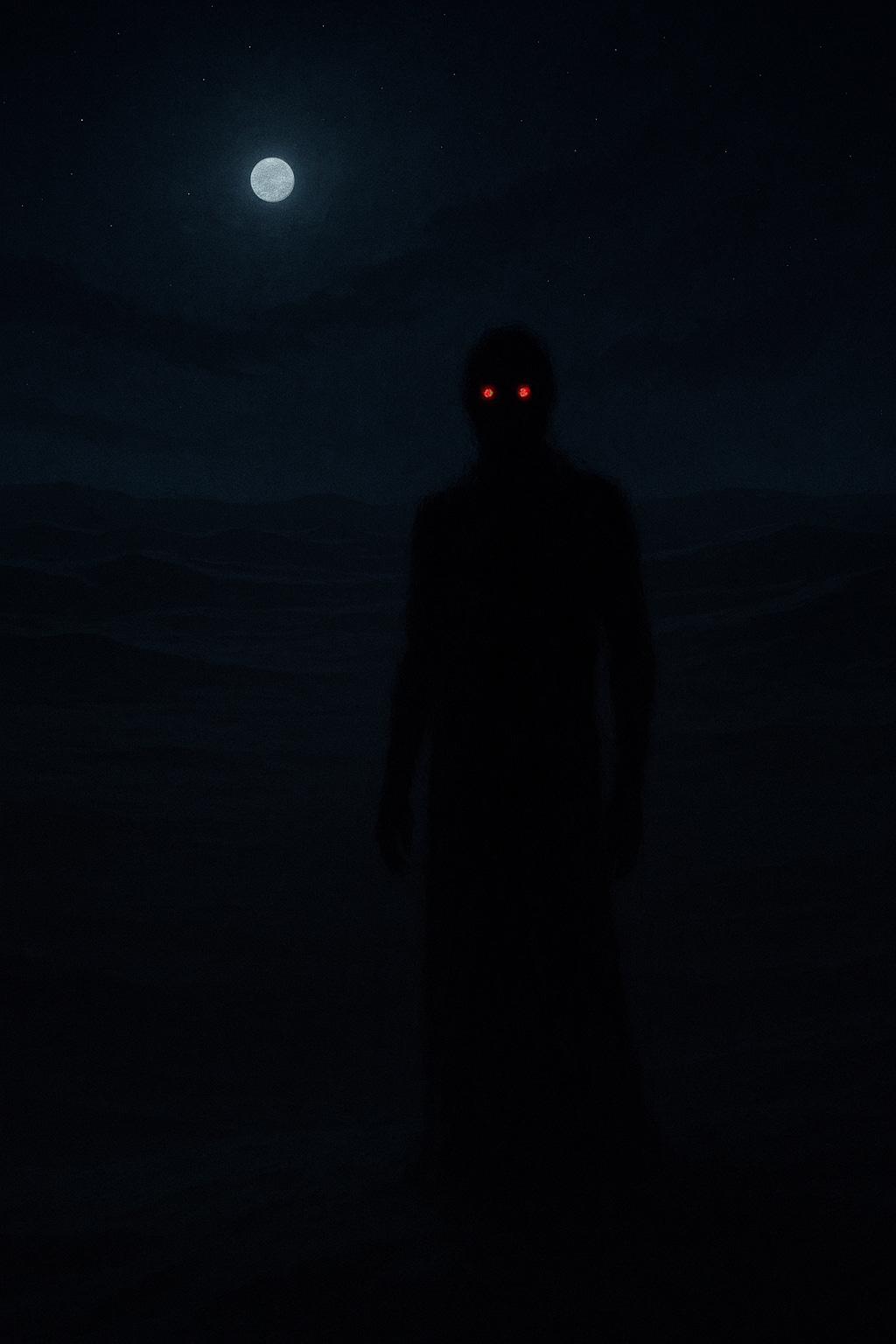
My pulse quickened as I put my hand on my rifle slung over my back out of habit. I fumbled for my radio, but my fingers felt numb and clumsy. I couldn’t tear my gaze away from those red pinpoints of light. They held me there, frozen in place. The wind died suddenly, leaving an unnatural stillness that made my ears ring.
Then it raised an arm, and pointed directly at me.
My throat constricted. I wanted to call out to the tower guards, but no sound came. The figure began moving again, not toward me, but parallel to the wall, keeping that exact same distance. It never turned away, those red eyes fixed on me as it glided across the sand.
I finally managed to get my radio to my mouth. “TOC, this is Echo Fife Bravo. Do you see anything out past the eastern wall? Over.”
Static crackled for a moment before a bored voice responded. “Negative, Sergeant. Nothing but sand. Over.”
“Are you sure? About one hundred meters out, just to the right of tower two? Over.”
This time there was a pause. I could almost see Martin frowning at his monitors, squinting at the feeds from our perimeter cameras.
“Negative, Bolt. I’ve got eyes on that whole sector. Nothing’s moving out there. You sure you’re not seeing things? Over.”
I kept my eyes fixed on the figure. It had stopped again and was perfectly still now, those red points of light boring into me.
“I’m looking right at it,” I said, my voice barely above a whisper. “How can you not see it? It’s right there.”
“Say again? You’re breaking up. Over.”
The radio slipped from my fingers, dangling by its cord from my vest. I reached toward my NODs (night optical device) I had stashed in my cargo pocket earlier to find my way around during blackout conditions. My hands trembled as I held them down over my eyes. Through the green haze of the goggles, the dunes appeared flat and distorted, but the figure, it wasn’t there.
I yanked the NODs away and looked again with my naked eyes. The red points still glowed, unwavering. My mouth went dry.
“Bolt, you okay out there?” Martin’s voice crackled through the radio at my shoulder.
I reached for it without taking my eyes off the figure. “Yeah, I’m fine. Just thought I saw something. False alarm.”
Why did I say that? The words had tumbled out automatically, as if some deeper instinct was telling me to keep this to myself.
The figure began to move again, this time directly toward the wall where I stood. My heart hammered against my ribs, but I couldn’t move. Those red eyes held me transfixed. Every instinct screamed to run, but my body wouldn’t obey.
At fifty meters, the figure stopped again. Now I could see it more clearly. It wasn’t just a shadow—it was darkness given form. The edges of its silhouette wavered like smoke against the moonlit sand, but maintained a roughly human shape. No features were visible except those glowing crimson points.
Then, I heard movement coming up on my left flank. I turned, half expecting, half terrified at the idea of seeing another set of eyes. Instead, it was one of the men from the artillery company, walking up to relieve the current tower guard.
“Hey Private Leonard,” I called out, relief washing over me. “Do you see that? Out there?” I gestured toward where the shadowy figure stood watching us, those red eyes still fixed on my position.
The soldier approached, rifle slung casually across his chest, and followed my pointing finger, squinting into the darkness. “See what, Sergeant?”
I turned back, finger raised to point at the red eyes, but the space where the figure had stood was empty. Just sand and shadows. I blinked hard, scanning the dunes, but there was nothing there. No movement, no glowing points, no impossible dark shapes.
“I...” My words died in my throat. “I thought I saw something.”
“Everything alright, Sergeant?” The soldier’s voice held that careful tone people use when they think you might be unstable.
“I’m fine,” I said, lowering my arm. “Just the shadows playing tricks, I guess.”
He nodded slowly, giving me that look soldiers sometimes give the others they think are losing it. I couldn’t blame him.
“Sure, Sergeant, whatever you say.” He climbed up to the tower, nodding politely before turning away.
I stayed frozen at my position for another ten minutes, scanning the darkness, but nothing appeared. Eventually, the cold drove me back inside. I returned to the TOC, half expecting Martin to make a comment about my strange radio call, but he was deep in conversation with someone from his Battalion.
Back in my CHU after the end of my shift, I sat on my cot with my head in my hands. The logical part of my brain offered explanations: fatigue, stress, the infamous desert mirages. But none of them felt right. The image of those red eyes boring into me was burned into my mind.
I didn’t sleep that day. I lay awake staring at the metal ceiling, listening to the generators humming outside, wondering if I was starting to crack. We’d all heard stories of guys coming back different, seeing things that weren’t there. It wouldn’t be the first time a soldier lost his grip out here. The desert does things to people. The isolation. The constant vigilance.
But I knew what I’d seen.
The next night, my equipment was still down. I sent in my report, tried to get some busy work done, and eventually found myself drawn back to the eastern wall almost as if pulled by an invisible thread. I told myself I was just doing my rounds, checking the perimeter like any good soldier would.
But I knew the truth. I was looking for it. The compulsion was so strong I didn’t even bother checking in with Martin first. I just went straight to the same spot where I’d seen... whatever it was.
I told myself I was being stupid. That I should be writing up requisition forms for the sensor repairs or catching up on sleep. But instead, there I was, standing in the biting cold again, staring out at the dunes.
Nothing. Just sand and stars.
I waited for nearly an hour, the cold seeping through my uniform until my fingers went numb. Nothing appeared. Part of me was relieved—maybe I had imagined it after all. The other part felt strangely disappointed.
I made my way back to my station, trying to focus on the broken equipment and the mindless tasks that filled the remaining hours of my shift. When morning came, I stumbled to my CHU, collapsed onto my cot, and for the first time in days, fell into a deep, dreamless sleep. No red eyes haunted me there.
The next night went the same way. I finished my reports, then found myself drawn to that same spot on the eastern wall. Again, nothing but sand, stars and the distant glow of Nasiriyah. The night after was the same. And the night after that.
By the fifth night, I’d almost convinced myself that what I’d seen had been a hallucination brought on by sleep deprivation and stress. Almost. There was still that nagging feeling in the back of my mind, a certainty that wouldn’t let go.
On the sixth night, I almost didn’t go. My equipment had finally been fixed by a contractor who’d shown up that afternoon, grumbling about the convoy from Tallil. I had actual work to do now, monitoring the sensor feeds, logging the data. But during a lull in work to do around 0300 hours, that familiar pull returned, stronger than before.
I tried to ignore it. I really did. But it was like an itch under my skin, impossible to dismiss.
“Screw it,” I muttered, securing my station and heading out.
The night was particularly cold, with a wind that cut through my fleece like it wasn’t even there. I hunched my shoulders against it as I made my way to the eastern wall. The stars were hidden behind a thin layer of high clouds, casting the desert in deeper darkness than usual.
I climbed to my spot, and started my vigil. I didn’t have to wait long. I was leaning against the wall, my back to the outpost, staring out at the endless dunes when that familiar sensation crept over me—the feeling of being watched. The hairs on my neck stood up before I even turned my head.
There it was. One hundred meters out, just as before. The shadow figure stood perfectly still against the rippling dunes, those twin points of crimson light fixed on me with terrible intensity.
Then it moved. The arm rose again, just as it had that first night, but this time it wasn’t pointing at me. The shadowy limb was extended outward, away from me, pointing toward something in the distance. I froze, unsure if this was a warning or a threat.
The figure remained motionless, that shadowy arm still outstretched, clearly indicating I should look in that direction.
I hesitated. Every instinct screamed not to take my eyes off the entity, as if it might charge forward the moment I looked away. But some feeling within me screamed at me that I needed to pay attention and look at what it was pointing at.
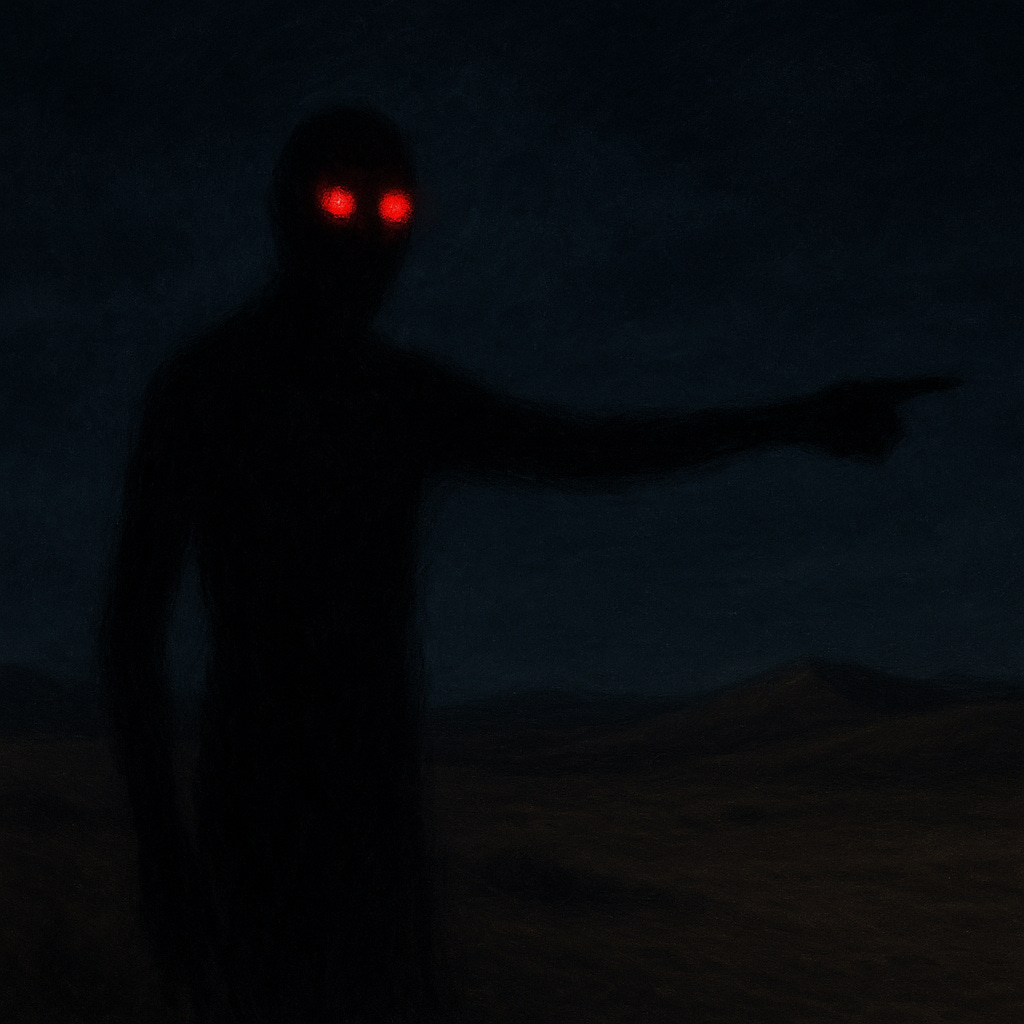
I slowly turned my gaze to follow the direction of its pointing finger. At first, I saw nothing but the familiar landscape of rippling dunes and darkness. Then, almost imperceptibly, something shifted in the distance—a subtle movement against the stillness of the desert night.
My breath caught. I blinked hard, trying to make sense of what I was seeing. The movement was too far away and the night too dark. I pull up my NODs and watch the area like a hawk. The movement comes again, clearer this time and I can start to make out details. I realize that I’m seeing people out there. People where there shouldn’t be any, especially at this time of night.
My heart races. Three figures, maybe four, moving with purpose across the dunes. I fumble for my radio.
“TOC, this is Echo Fife Bravo. Multiple personnel, eastern sector, approximately eight hundred meters out. Moving in formation. Over.”
A pause, then Martin’s voice crackles through. “Echo Fife Bravo, say again? You seeing shadows again, Bolt?”
“Negative, TOC. This is real. Three to four personnel, moving tactically. Check your cameras, sector two-niner. Over.”
I wait, heart pounding, as the silence stretches over the radio. Then:
“Shit, you’re right.” Martin’s voice is different now, all business. “I’ve got them on thermal. Four tangos, moving in a tactical formation. How the hell did you spot them before our systems?”
I don’t answer. Can’t answer. Because I’m looking back at the shadow figure with the red eyes. It hasn’t moved, arm still extended toward the infiltrators.
“QRF is moving,” Martin says through the radio. “Stay where you are, keep eyes on Bolt. Do not engage.”
The outpost erupts into controlled chaos behind me. I hear the quick shuffle of boots, the metallic clicks of weapons being readied. The Quick Reaction Force is deploying—six men who will intercept the approaching threat.
But I can’t take my eyes off the shadow figure. Something passes between us in that moment. A silent acknowledgment. As if we’ve entered into some unspoken pact that I don’t fully understand.
I look back at the red eyes and I get the feeling they are satisfied. Their glow seems to pulse once, brighter than before, as if confirming my suspicion.
Without warning, a violent gust of scorching air slams into me, completely at odds with the January chill. The desert wind carries stinging particles that force me to shield my face. Sand scrapes against my cheeks and finds its way into my eyes despite my efforts to protect them.
“Damn it,” I hiss, blinking furiously, tears streaming down my face as my body tries to flush out the irritants.
When my vision finally clears, the figure is gone. Just empty desert stares back at me, innocent and unchanged, as if nothing had been there at all. But I know what I saw. I know what it did.
Behind me, the QRF is already moving out through the small guard post entrance at the north side of the base. Their shadows stretch long across the sand under the moonlight as they fan out in a practiced formation. I hear Martin barking coordinates through the radio, directing them toward the infiltrators who are still unaware they’ve been spotted.
I watched the QRF move with practiced precision into the darkness, fading into shadows themselves. I stayed at my post, scanning the desert for any sign of the red-eyed figure, but it remained gone. The radio chatter in my ear told me the team had made contact. Short bursts of gunfire echoed across the dunes, but it was over quickly.
Three hours later, as dawn broke over the outpost, I sat in the TOC with SSG Martin. His face was drawn but satisfied as he handed me a steaming cup of coffee.
“Been a hell of a night,” he said, his voice low enough that the others in the room couldn’t hear. “How did you spot them, Bolt? They were using every trick in the book to stay hidden.”
I stared into my coffee, What could I say? That a shadow with red eyes had pointed them out to me? I’d be on the next transport to a psych evaluation. “Just got lucky, I guess.”
Martin snorted. “Bullshit. But I don’t care how you did it. You did good.”
Two days later, Martin pulled me aside during my shift. We walked to the small smoking area behind the TOC, a square of gravel with two folding chairs and a coffee can for butts. No one else was around.
“Thought you might want to know what the interrogators found,” he said, lighting a cigarette. The flame briefly illuminated the dark circles under his eyes. “Those guys you spotted? They’d been setting up for days.”
“Setting up?” I asked.
Martin exhaled a plume of smoke. “They had a mortar tube and about a dozen rounds cached in the sand not far from where we intercepted them. Word we got back is that they’d been moving it piece by piece over the last three nights after scoping us out about a week ago.”
That lined up with when I first saw the eyes. I swallowed, my throat suddenly very dry. “A mortar attack?”
“Yeah. The plan was simple but nasty,” Martin continued, crushing his cigarette under his boot. “They were going to set up just beyond our sensor range and drop those shells right onto us while we all slept.”
I felt a chill that had nothing to do with the desert night. My mind flashed back to my first impression of COP 9: one good mortar strike could wipe us all out.
“Jesus,” I whispered. “With the way this place is laid out...”
Martin nodded grimly. “Yeah. Exactly.” He didn’t elaborate. Neither one of us needed it. We both knew how things could have turned out differently.
There was talk for a little while over an award or recognition, neither of which ever came. I never cared either way, as I knew what really saved us that night. About two months later, command came down to close up shop at COP 9 and hand it over to the Iraqi forces.
I never saw the eyes again, even though I continued to step out and look over the walls sometimes in the dead of the night.