
So the other day, I was talking with Kristin McTiernan for her Youtube channel when she mentioned my knife fight scenes in Eastern Blood Price and how they stood apart from what one usually sees in fiction. I demurred a bit, explaining my basic thoughts on the matter, not really thinking that I had much of anything special to offer in the ways of insight to a fight scene.
To make a long story short though and cut to the chase as it were (hah, puns!) I ended up coming up with this to explain why I think most scenes in fiction depicting bladed combat are unrealistically long to the point of breaking suspension of disbelief and why my own get right to the point. (Ha, more puns!)
Part One: Who Am I and Why Do You Care What I Have to Say
Let’s start with the obvious questions out of the way and establish my credentials on the topic. Because we all know that everyone and their mother on the internet has “‘pinions” on hand-to-hand combat and how it works out. So up front, no, I have not ever been in a knife fight. How can we tell that, outside of the fact that I just said so? Because I’m here to tell you that I’ve never been in a knife fight!
See, that’s one of the first lessons drilled into everyone that studies the martial art I practiced, Pekiti Tirsia Kali. It’s also a lesson that gets reiterated regularly, and with various different pithy ways of stating it. “No one wins a knife fight.” “The loser dies in the alley and the winner dies in the ambulance.” “If you pull a blade, be ready to be cut.”
Pekiti Tirsia Kali is different from your run-of-the-mill Karate class ran out of a rented strip mall space. As far as the mindset and practice go, it’s got more in common with the knife techniques trained by the British commandos in World War II than your eight year old's Taekwondo class. That's not a joke by the way, Pekiti Tirsia is the official hand-to-hand combat system of the Filipino Special Operations Forces. I'll talk more about it another day but you should get the idea, it's a serious martial system built for real combat.
So if I don’t have a ton of real world knife fight experience under my belt, then surely I’m some sort of high ranked practitioner of the art right? Nope, sorry to disappoint again but I’m not. To tell the truth, I don’t think I ever received any kind of ranking at all, I certainly never tested for one. If you’re looking for real world masters and teachers, I can point you in their direction.
You have the ones most everyone recognizes of course, Doug Marcaida whom you may recognize from Forged in Fire and Dan Inosanto who trained Bruce Lee in Filipino Martial Arts back in the day. Then you have the big names in the system itself. Grand Tuhon Leo T. Gaje Jr. is the head of the system, while Tuhon Bill Mcgrath is the head of Pekiti Tirsia International and Tuhon Rommel Tortal is the head of PTK World Federation as well as the inheritor of the system from Grand Tuhon. I have received distance instruction and poured over lessons from all of these men. For my own personal teachers, I had the privilege of learning under Guro Sean Dapilmoto and Agalon Rob Slomkowski in the San Antonio area as well as Tuhons Arlene and Malcolm Stevens in the Baltimore area.
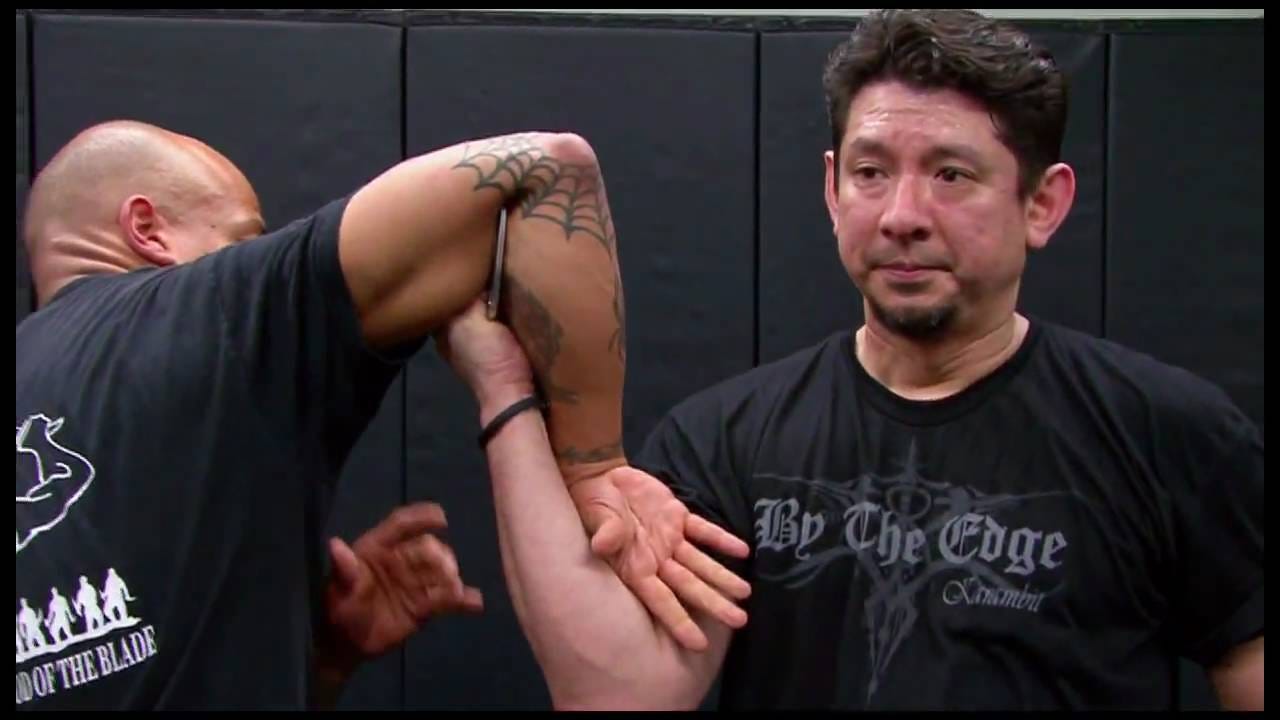
All this to say that while I am not a master or someone who has dedicated years to formal study of the art, I learned at the feet of those who have, and I remember my lessons well. That I am not a master Kali practitioner is due to my own inability to dedicate the time necessary, not any lacking in their teaching. My words here are not pulled out of my ass, but are tried and true observations made by people who know.
Part Two: Some Basic Observations
So to understand why I write the knife combat in my stories the way I do, we first have to go over some basic, unavoidable truths about hand-to-hand combat in general. If you've had any real training on martial arts or combat systems then you're probably going to be nodding along with what I'm about to say, thinking it's common sense. But if my time in the Army has taught me one thing, it's that common sense ain't so common. So for everyone else, this quick primer is for you.
1) A physical fight in close quarters tends to go one of two ways: either one side is so physically superior or possesses so much more knowledge and experience that they completely and swiftly overwhelm the other party; or, if the two sides are more evenly matched, the affair devolves essentially into a battle of attrition, both sides attempting to wear the other out first while conserving their own energy.
What this means: The bulk of hand-to-hand combat between human beings involves a case of fast escalation of hostilities followed by one of the two combatants quickly establishing overwhelming physical superiority over their opponent. This is where we see the viral videos of two young men arguing, preparing to fight, only for one to immediately knock their opponent out with a single punch or quickly manhandle them into yielding. This can be through superior speed, strength, or skill but most often involves superior strength.
In cases where this does not happen, due typically to evenly matched characteristics between the two, the fight naturally degrades into exchanges of strikes, grappling, and maneuvers where each side tries to outlast the other. This is where we see the videos of 5+ minute long fights between individuals that almost inevitably end up with them wrestling each other on the ground, as well as the bulk of MMA matches. The difference we see here is in skill between the two examples but not in practical outcome of how the fight flows.
2) There is a point at which physical disparity between combatants is so great that no amount of skill or experience can reliably overcome it. That threshold is not fixed but varies depending on the relative physical and experiential capabilities of the fighters.
What this means: Skill and experience will trump pure physical advantages such as size, strength, speed, or endurance but this is only up to a point. And that point changes based on the differences between the two fighters. The more skilled one fighter is, the greater their capability against someone who has a significant physical advantage against them. However, past a certain point the physical advantage becomes so overwhelming that no amount of skill can close the gap.
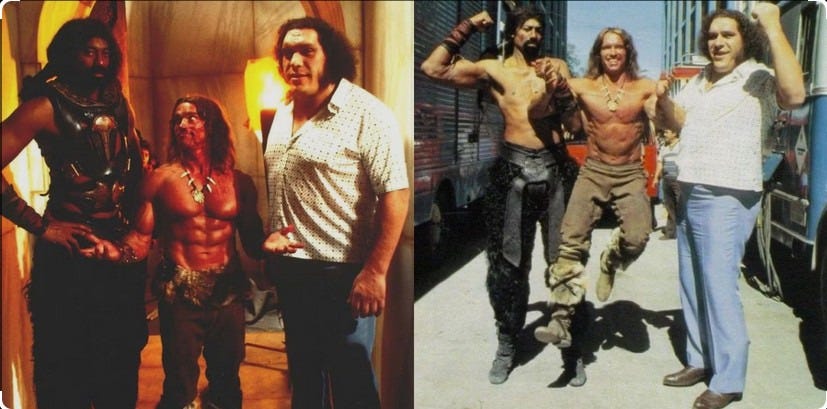
To put this into a quick and dirty example, assume for a moment that both Bruce Lee and Andre the Giant were both still alive, in the prime of their life, and put into an empty space with no escape but to beat the other in a fight. While there is a nonzero chance that the 5’8, 140 lbs Bruce COULD beat the 7’4, 520 lbs Andre in these circumstances, the chances that he WOULD are pretty damn small.
And now we turn things on their head with this final observation.
3) The introduction of blades both increases the chances of the first outcome exponentially as well as nearly completely tosses normal hand-to-hand combat dynamics involving strength and endurance on their head. In a close quarters blade fight, be it with knives, machetes, short swords, what have you, the winning physical parameters are speed, reflex/reaction time, and spatial awareness. The moment blades get introduced into a fight, the question changes from who is the strongest to who is the fastest, because the goal has now become for either opponent to get in, get their opponent with a lethal strike, and then get out without taking lethal damage themselves. Or preferably any damage at all if they can manage it.
Part Three: Bringing it all Together
It's that final point that feeds into why I wrote the blade work in Eastern Blood Price to be short, precise, and brutal. Because in reality, that's how it works. People underestimate just how deadly and debilitating even small cuts can be.
I personally lay a large portion of this to just how unaccustomed people in the West are these days to witnessing much less experiencing real bodily trauma. That coupled with the the tradition in our stories of showing heroes and villains clashing epically for absurd amounts of time all while landing crippling wounds on each other that they somehow shrug off through sheer willpower. But that's a rant for another day. For now, we focus on realism and how quickly a real world blade fight can go.
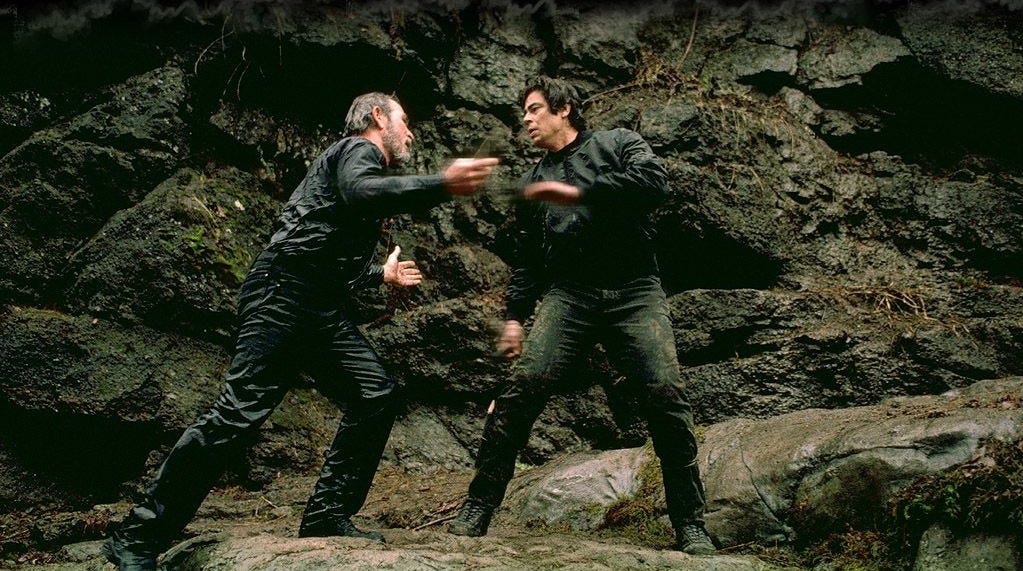
This is something that has been studied for many years, with various ways of testing the hypotheses. The most common of these tests is one that most practiced firearm users will have heard of, the infamous “21 foot rule” also known as the Tueller Drill. For anyone who is unfamiliar, the testing has found that for an average person, if an attacker is within 21 feet of you then you are unlikely to be able get your gun from your holster and get a shot on them in time before they stab you. An average man is able to cross the distance of 21 feet in about 1.5 seconds. Similar studies have shown that the average “knife fight” last approximately 23 seconds, with about half lasting less than 14 seconds and around 80% lasting less than 32 seconds. And all of that is faster than it just took me to re-read this paragraph out loud, give it a try and I hope that it drives home the point.
So moving on to bringing this back into the realm of fiction, I write with an eye towards realism in how things work in combat. Please excuse me tooting my own horn, but I'm going to use an excerpt from Eastern Blood Price to show how a bit about how a realistic knife fight in fiction would look. Consider the following:
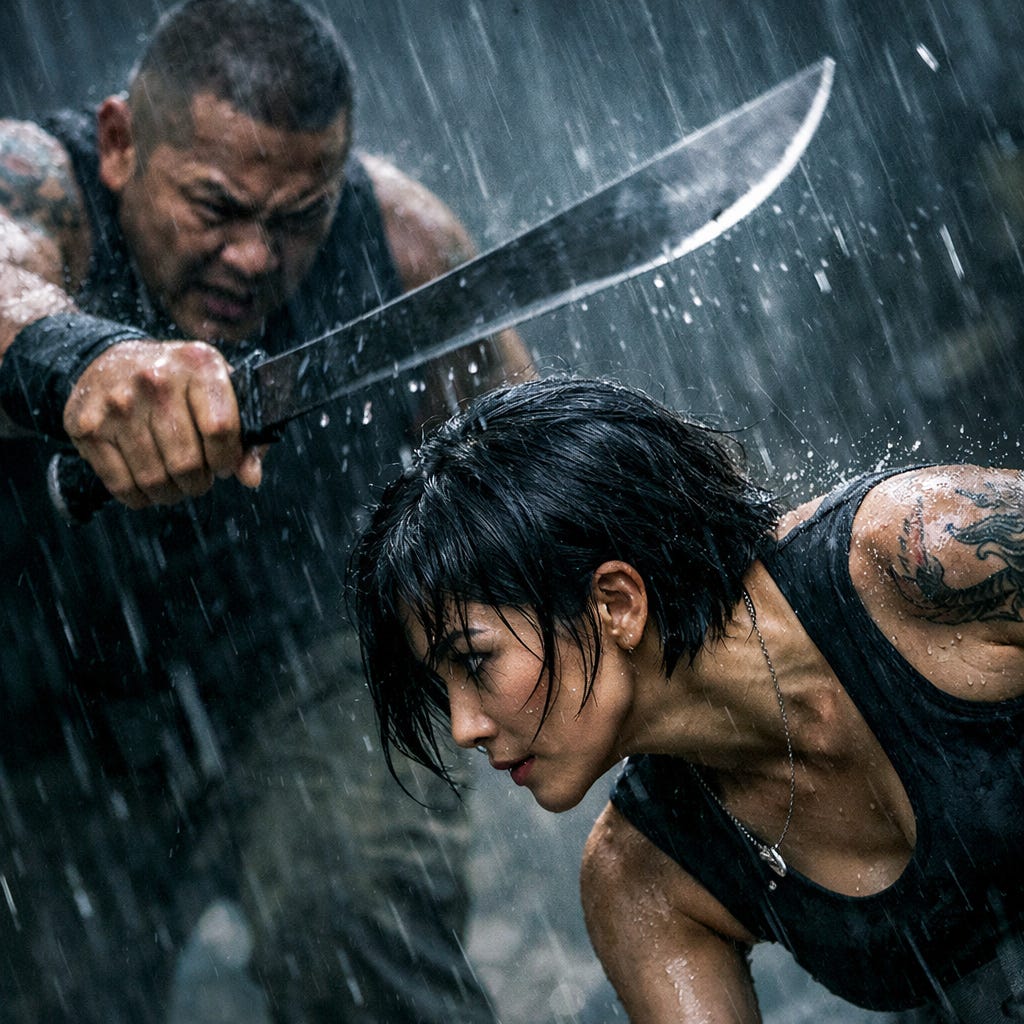
The machete continued its deadly arc, cutting through space that should have contained Anya's flesh and bone. But with timing so perfect it appeared choreographed, she ducked—a slight, economical movement that allowed the blade to pass a hairsbreadth above her head. The weapon sliced through empty air, disturbing nothing but raindrops.
Chakri's momentum carried him forward, his body temporarily off-balance from the force he'd put behind a strike that met no resistance. In that fractional moment of vulnerability, Anya moved.
The kerambit sat in her grip as if part of her hand. With surgical precision, she flicked her wrist, the blade finding the exact point where Chakri's flexor tendon ran beneath the skin of his wrist.
The cut itself was almost delicate, a precise incision. But the effect was immediate. Blood sprayed in a crimson arc, droplets merging with the rain to create pale red patterns against the concrete. The machete clattered from Chakri's suddenly nerveless fingers, striking the ground with a metallic ring that echoed in the confined space.
So what we have here is a very basic set of movements. Chakri tries to bisect her with a diagonal slash coming from his right shoulder down to his left hip. We call this an "Angle 1" in Kali. She ducks under it at the last second, leaving Chakri momentarily off balance and exposed. She quickly takes advantage of the vulnerability by taking her kerambit and slashing Chakri across his right wrist deep enough to sever the tendons, causing him to lose the ability to hold the weapon.
This maneuver is part of an established doctrine within PTK known as “defanging the snake” and it refers to the tactic of attacking/counterattacking the opponent’s limbs in order to render them no longer a threat. While the timing of the maneuver, known as “gunting” or “scissors” in English, requires practice the actual cut is absurdly easy and requires little force with a properly sharp blade. As anyone with unfortunate experience with compulsive cutters can attest.
The keys here are Anya's spatial awareness, her timing, and the speed of her reactions as well as her counter. Through her skill and experience, Anya was able to judge the angle of the attack, move herself appropriately to avoid it while ensuring she was positioned to perform her counter. Then she executed.
Now obviously, in the real world someone with a machete coming at their face is going to react with more than just a slight duck to dodge it but for the case of fiction we want to err on the side of "rule of cool" of course. Equally obviously, given my stated predisposition to realism, Anya is working with an advantage here that allows her to pull this off that I've not told you. If you want to know more, you can discover it in the book.
Anyway, in this one simple exchange we see how through superior skill, timing, reflexes, and spatial awareness that Anya quickly moves to establish the fight dominance that I spoke about earlier.
And in a real world incident, things would most likely end right here. Because in the real world, that wound is not only extremely debilitating (someone with their tendons cut like this will have months if not years of physical therapy to look forward to in order to gain even a fraction of usage out of that hand again) but also actually a slow death sentence, as cutting deep enough to get the tendons also necessitates cutting the radial artery, which can easily end up with a bleedout if untreated.

Obviously, the fight against Chakri doesn't end exactly right there in Eastern Blood Price but it still serves to demonstrate what I'm talking about. In the end, real knife fights don’t give you time for elaborate choreography, they’re over almost before they start and typically decided by a single, precise strike. By keeping my scenes short, precise, and brutal, I aim to honor that reality while delivering the tension fiction demands. I like to think it puts me a cut above the rest (thought I forgot, but one last to send you off with!), and I hope you’ll enjoy reading these exchanges in my works as much as I do writing them.
Alright folks, the Good Idea Fairy’s been buzzing around and it looks like it got the XO because he’s looking for bodies, which means it’s time to put out our smokes and make ourselves scarce.
—Riley
Good article!
Just saw your interview on Nonsense-Free. Great chat!
My best strategy to win a knife fight is to shoot ‘em.